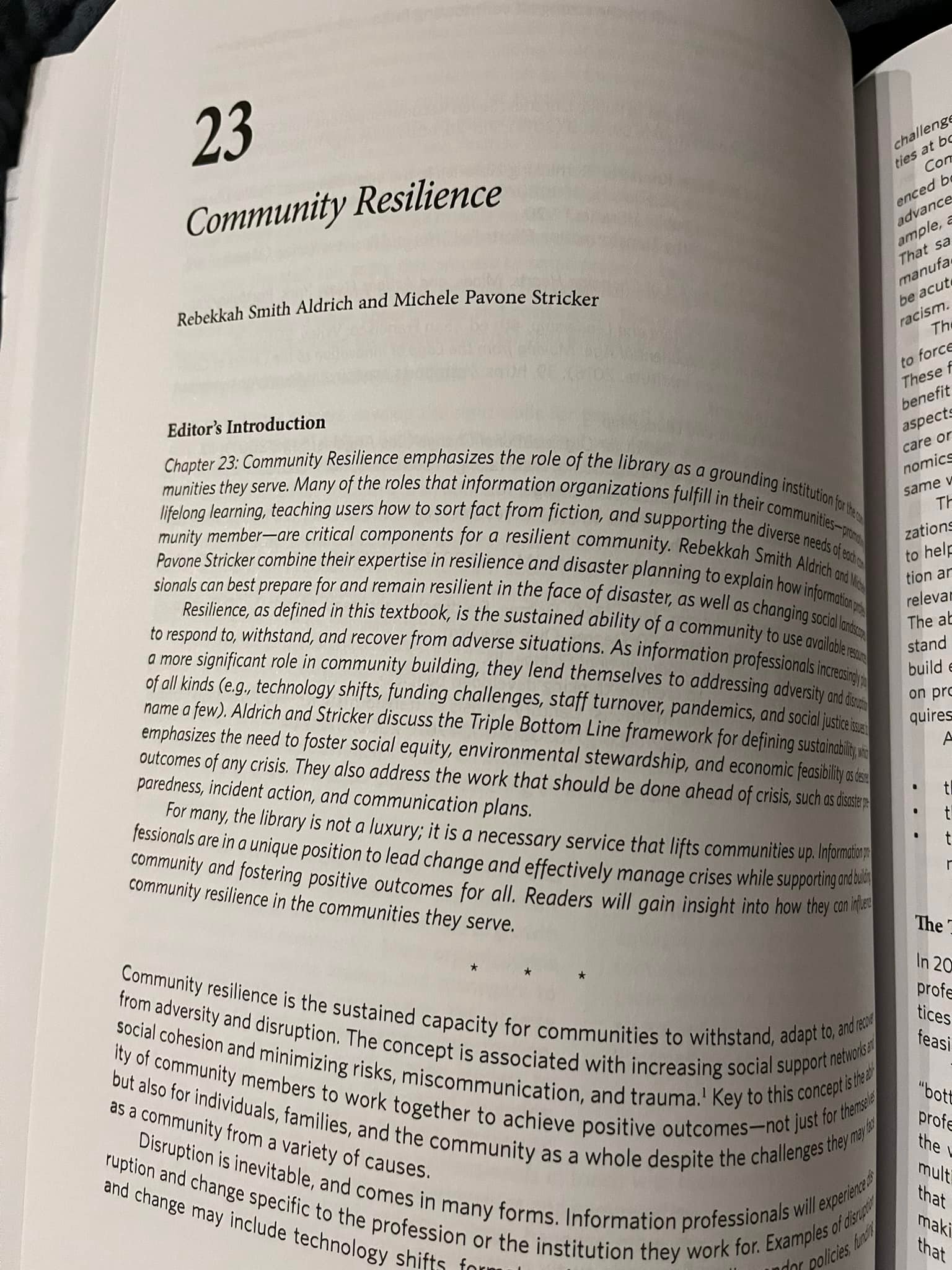
“It’s systemic. It’s not just the environment — it’s how we treat people. It’s how we spend money. It’s the choices we make every single day in almost every area of our lives.” –Rebekkah Smith Aldrich
You can read the full interview here. Thanks Kate!
My latest column for Library Journal features the new New Canaan Library
My latest column for Library Journal features the work of Lisa Oldham and Micaela Porta at the New Canaan Library (the newest member of the Sustainable Libraries Initiative!) who are doing amazing work to ensure that no materials used in their construction project were created with forced or slave labor. They are partnering with Design for Freedom to contribute to a database to surface ethical manufacturers to help other building projects do the same.
The American Library Association’s Public Programs Office has chosen our latest book for their book club!
Cover of Libraries & Sustainability
ALA has announced the “Libraries and Sustainability” Virtual Book Club, a series of three virtual, interactive conversations about incorporating sustainability into librarianship to be held in November and December 2022.
Library workers who would like to be considered for one of the 100 available spots should apply online by August 19.
Participants will be expected to attend each of the three virtual book club sessions listed below and read the three corresponding chapters in advance. Sessions will not be recorded.
Applicants will be notified of their acceptance by September 5. Sessions will take place over Zoom; the link will be provided to participants once their registration is confirmed.
“Libraries and Sustainability: Programs and Practices for Community Impact” offers an easy-to-digest introduction to what staff at a range of libraries have accomplished in incorporating sustainability into their decision-making and professional practices. In addition, a discussion about the role of economics and sustainability will challenge readers to stretch in new ways to positively impact their communities.
The book club series consists of three 90-minute virtual book clubs. Each session will feature one chapter from “Libraries and Sustainability,” and will offer a live conversation with the chapter’s authors, small-group breakout discussion, and Q&A time with the authors.
Sessions will include:
Monday, November 14, 2022, 12:30 – 2:00 p.m. CST
“Libraries in the Doughnut Economy,” with Monika Antonelli, René Tanner, Rebekkah Smith Aldrich and Adrian K. Ho
The current challenges brought on by climate change require bold thinking and action to turn the tide. The authors will introduce the concept of “Doughnut Economics” and explore how library leaders can supercharge a just transition to an economy that is less extractive and puts the well-being of our fellow humans at the center of decision-making.
Participants in this session will:
Understand the conceptual model of Doughnut Economics and how it can help libraries contribute to a sustainable and resilient society
Explore the importance of the Knowledge Commons for a more just society
Walk away with an understanding of how to think like a “21st-century economist”
Thursday, December 1, 2022, 12:30 – 2:00 p.m. CST
“Walking the Path to Sustainable Library Certification,” with Jill Davis, Jennifer Ferriss and Lisa G. Kropp
Being a sustainable library means using the triple bottom line of sustainability — environmental stewardship, social equity and economic feasibility — to guide decision-making at your library. From large decisions (e.g., how to operate your building sustainably or achieve buy-in from staff and stakeholders) to small decisions (which copy paper to buy), libraries can demonstrate leadership in the area of sustainability. Using this methodology makes for a library that lives its values out loud, treats its workers well, and is a strong community co-creator to ensure that residents thrive.
Participants in this session will:
Understand how the triple bottom line of sustainability can be applied through library operations, service/program design and outreach
Hear from three library leaders who have done this work and achieved Sustainable Library Certification status
Walk away with an empowered mindset to be the change they want to see in the world
Wednesday, December 14, 2022, 12:30 – 2:00 p.m. CST
“Rapid Library Disaster Response and Recovery for Community Resiliency” Michele P. Stricker
A key element to successfully responding to a major disaster is the overall preparedness of individual citizens, families and the community as a whole. This session will provide an overview of tools to help library leaders overcome challenging disaster scenarios, mitigate risk, and focus on helping libraries rebound quickly from a disaster so their communities become more resilient.
Participants in this session will:
Learn how to hone situational awareness to improve response decisions in the aftermath of a disaster
Receive an introduction to disaster preparedness models that have been proven effective
Walk away with a renewed focus to ensure communities thrive thanks to a library’s preparedness for the next disaster
My latest column for Library Journal shines a light on the incredible work of libraries becoming certified through the Sustainable Libraries Initiative’s Sustainable Library Certification Program
“On Earth Day 2022, Suffolk County, NY, Executive Steven Bellone announced a $12 million investment in electric vehicle charging stations. He chose the Lindenhurst Memorial Library (LML) as the location for the press conference. “That’s why we’re at the Lindenhurst Library today, because they have been in the lead. I want to thank them for their vision, their leadership…. We truly appreciate Lindenhurst being out in front on such an important issue.”
LML was the second library in the country to be certified under the Sustainable Libraries Initiative’s Sustainable Library Certification Program, a program Library Director Lisa Kropp has credited not only with catching the eye of the county executive but also one that helped the library staff to prepare for one of the biggest disruptions to modern life as we know it, COVID-19. “I’m convinced that because our library was involved in sustainable work over the past two years (prior to the pandemic), we were ready to bounce back from this social disruption—and show our grit and resiliency in the face of adversity.”
The award-winning Sustainable Library Certification Program, the first of its kind in the world for libraries, helps library leaders tackle what has proven to be a massive challenge: how to run our libraries and develop strategies that combat climate change while building community resilience.
HOW IT WORKS
The program provides methodology for helping a library’s leadership build buy-in and make progress on the topics surrounding sustainability in their organization using the triple bottom line definition of sustainability. The goal of the work is to influence the mindset of library leaders—at all levels of the organization—to ensure that as we make decisions, large and small, we do so through this framework of considering not only the cost, but also the environmental and social impact…”
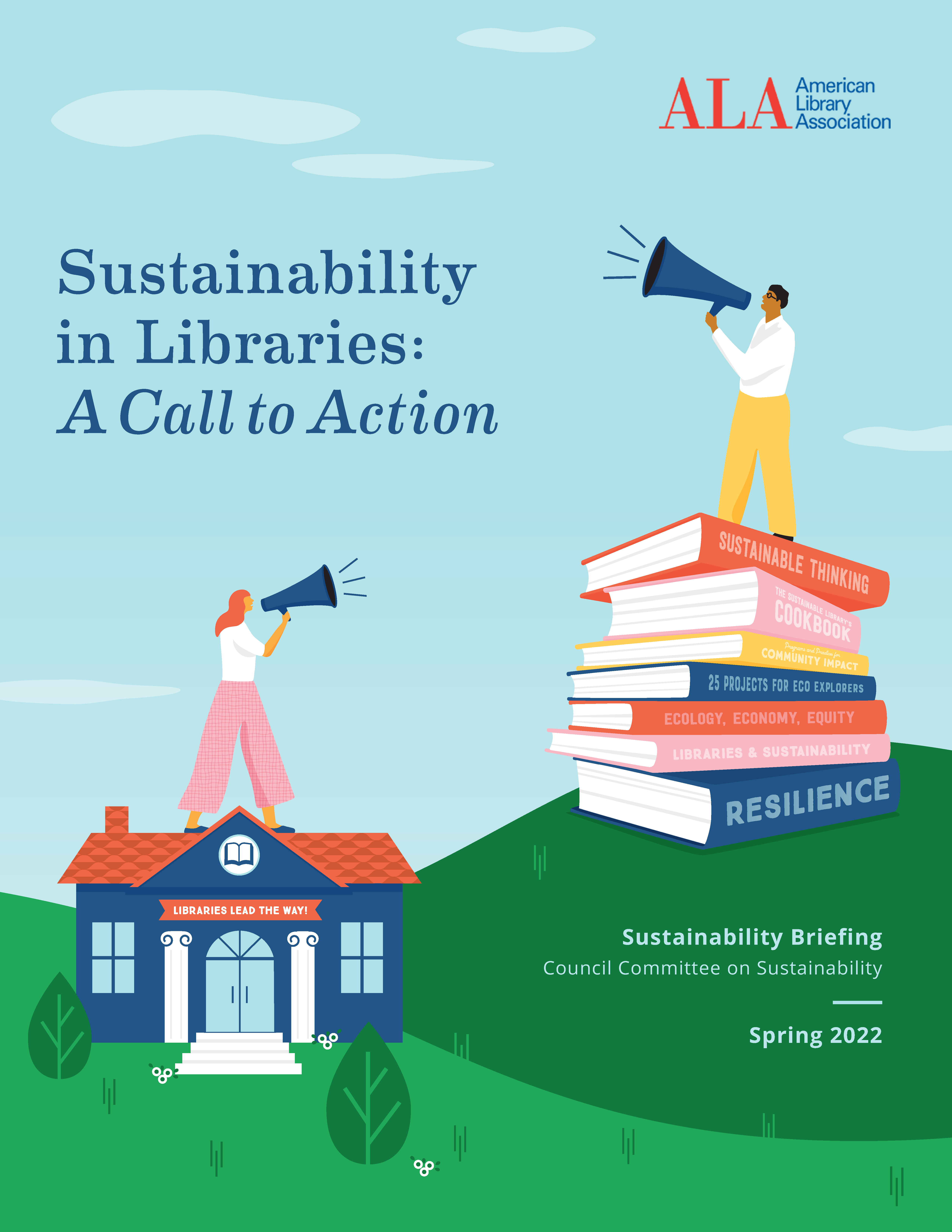
“Sustainability in Libraries: A Call to Action” released by the American Library Association’s Council Committee on Sustainability
Climate change is the single greatest threat to global health and this generation’s grandest challenge, but many library leaders feel overwhelmed, even paralyzed about where to start. “Sustainability in Libraries: A Call to Action,” a new briefing from the ALA Council Committee on Sustainability, is here to focus attention on how the library community can accelerate their understanding and action, in the areas of climate change mitigation and adaptation.
Readers will learn:
Why ALA has adopted the “triple bottom line” definition of sustainability as a core value of the profession;
How libraries can take the lead on climate adaptation;
Why climate justice work is equity, diversity, and inclusion work;
How many in our field are already answering the call for leadership on the topic of sustainability;
How ALA, as an association, is living its values out loud on this topic; and
Simple, practical steps anyone can take to get started.
ALA President Patty Wong focused on sustainability during her presidential year, noting in her kickoff American Libraries column about this topic, “This is the time to stand together in solidarity…to meet the enormous challenges of the climate crisis and summon the effort to deal with its impact. Climate change is a unifying issue for libraries across the globe, and we must commit to doing all we can to prepare our communities for its effects.”
The authors of the briefing, members of the new ALA Council Committee on Sustainability, represent public, school and academic libraries and have strong ties to the ALA Special Task Force on Sustainability, the Sustainability Round Table, the Sustainable Libraries Initiative and the Executive Board of ALA.
This briefing is free to download through the new LibGuide on Sustainability, curated by ALA Librarian & Archivist, Colleen Barbus.
Recent blog post on Massachusetts Library System’s Blue Marble Library Blog
I was recently invited to write a blog post for the Massachusetts Library System’s Blue Marble Library blog on the Sustainable Libraries Initiative’s Sustainable Library Certification Program and you know I jumped at the chance! Thanks Gabrielle!
My latest column for Library Journal was almost just three words long.
When I first pitched my latest column idea to Library Journal Executive Editor Meredith Schwartz it went a little something like this: “What if it just said “Climate Action Now.” and we just repeated that line a few hundred times?” She politely steered me in a different direction…
“Climate scientists predict we will look back on the years 2020 and 2021 and think to ourselves, “Those were the good old days.” Record-setting heat, record amounts of scorched earth thanks to wildfires, record numbers of tropical storms, and a record number of freak natural disasters like derechos—that’s what 2020 had to offer. And 2021 hasn’t been much better.
In October, the national security community, including the departments of Homeland Security and Defense as well as the National Security Council and director of national intelligence, issued reports on the climate risks we face. They researched what the inevitable food shortages caused by climate change will mean for national security, what fights for clean drinking water will do to communities and nations, and the effects of the predicted massive climate migration by folks displaced by climate change.
In September, more than 200 medical journals, including The Lancet, the New England Journal of Medicine, and the British Medical Journal, issued an unprecedented joint statement, “Call for Emergency Action to Limit Global Temperature Increases, Restore Biodiversity, and Protect Health,” urging world leaders to cut heat-trapping emissions to avoid “catastrophic harm to health that will be impossible to reverse,” naming climate change as the “greatest threat” to global public health. “Despite the world’s necessary preoccupation with COVID-19, we cannot wait for the pandemic to pass to rapidly reduce emissions.”
Also in September, thanks to Executive Order 14008, 24 major federal agencies issued adaptation and resilience plans that outline the steps each agency will take to ensure their facilities and operations adapt to and are increasingly resilient to climate change impacts. Identified risks include “rising costs to maintain and repair damaged infrastructure from more frequent and extreme weather events, challenges to program effectiveness and readiness, and health and safety risks to federal employees who work outside.” The federal government has recognized through these reports that by acting now to better manage and mitigate climate risks, they will “minimize disruptions to federal operations, assets and programs while creating safer working conditions for employees.”
There is no more time to waste. Climate action is needed NOW. Libraries should be visible leaders and partner in this effort not only to protect the assets the public has entrusted them with but also to ensure library workers and community members have the support they need, through libraries, in the face of disruption.
What does your library’s climate adaptation and resilience plan look like? If you don’t have one, you’re not alone. So, let’s get started…”
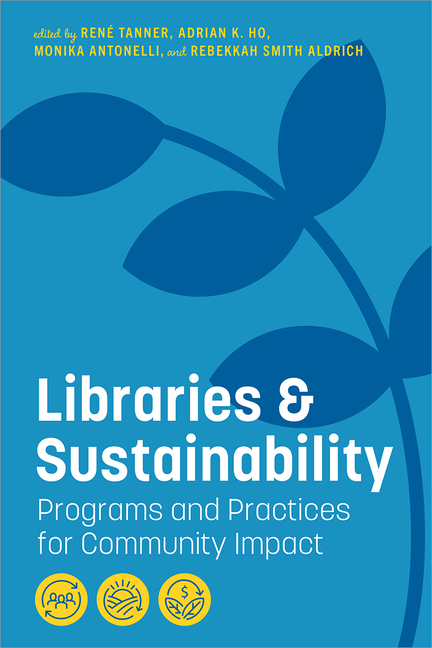
New book project with Rene, Monika, and Adrian is out!
I could not be more excited to announce that a project many years in the making has arrived for public consumption! This project came out of work from the American Library Association’s Special Task Force on Sustainability. I was lucky enough to co-chair that task force with the amazing René Tanner and we got to work with Monika Antonelli and Adrian Ho – our co-editors of the book – through that task force. One of the 52 recommendations that was provided in the final report of the task force was to produce a book with ALA Editions to highlight the topic and the good work going on the field. So here it is!
“As a core value of librarianship, sustainability is not an end point but a mindset, a lens through which operational and outreach decisions can be made. And it extends beyond an awareness of the roles that libraries can play in educating and advocating for a sustainable future. As “Libraries and Sustainability: Programs and Practices for Community Impact,” published by ALA Editions, demonstrates, sustainability can also encompass engaging with communities in discussions about resilience, regeneration, and social justice. Edited by René Tanner, Adrian K. Ho, Monika Antonelli, and Rebekkah Smith Aldrich, members of ALA’s Sustainability Round Table and ALA’s Special Task Force on Sustainability, this book’s many topics include:
a discussion of why sustainability matters to libraries and their user communities;
real-life examples of sustainability programming, transformative community partnerships, collective responses for climate resilience, and green building practices;
lessons learned and recommendations from library workers who have been active in putting sustainability into practice;
the intersection of sustainability with the work of equity, diversity, and inclusion;
suggestions regarding the revision of library and information science curriculum in light of the practical need to build community resilience;
an examination of how libraries’ efforts to support Doughnut Economics can bolster the United Nations’ work on the Sustainable Development Goals, which seek to address the global impacts of climate change; and
potential collaborators for future sustainability-related initiatives.
Tanner is the Science Librarian and Head of Research Services for Olin Library at Rollins College in Winter Park, Florida. She has previously published on the topic of seed libraries and their importance in the development of food appreciation and local knowledge of food crops. Ho is coordinator of digital scholarship at the University of Kentucky Libraries in Lexington. has given presentations about libraries, sustainability, and resilience. His ORCID ID is https://orcid.org/0000-0002-7417-7373. Antonelli is an outreach librarian and professor at Minnesota State University, Mankato. She is the co-editor of the book “Greening Libraries,” which in 2013 received the Best Business Book award at the Green Book Festival. She has earned permaculture certification, and currently serves on her university’s Environmental Committee. Aldrich (MLS, LEED AP) is Executive Director, Mid-Hudson Library System (New York). She is the sustainability columnist for Library Journal. She is the co-founder of the Sustainable Libraries Initiative and a founding board member of the American Library Association’s Sustainability Round Table. Named a Library Journal Mover & Shaker, she is a frequent national presenter and writer on the topic of leading libraries forward in smart, practical, and effective ways.”