I was thrilled to be interviewed by Adriane Herrick Juarez for the Library Leadership Podcast recently! Check out episode 37: Sustaining Your Library’s Future in an Uncertain World!
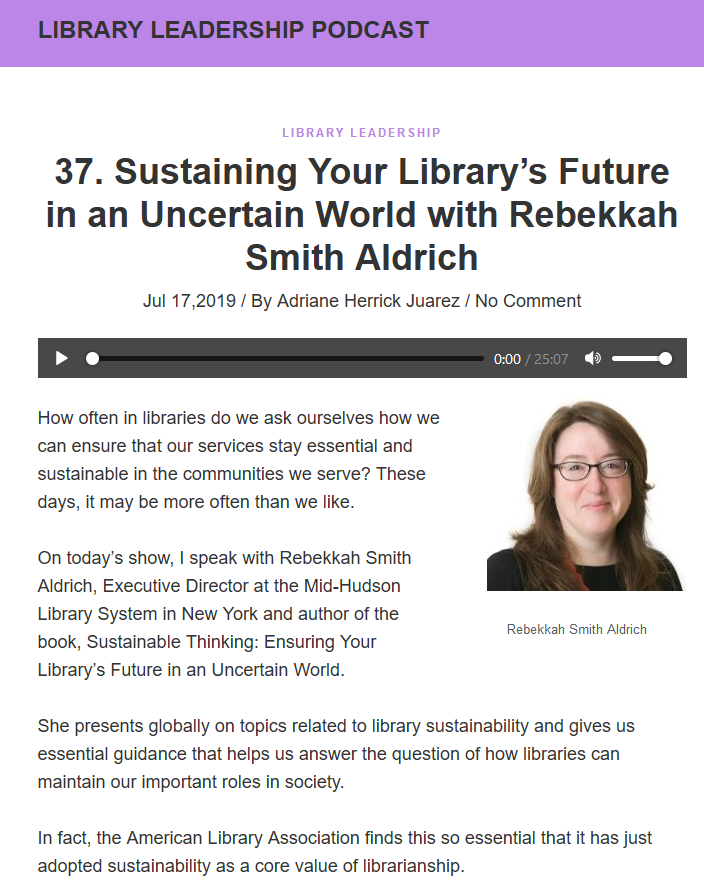

I was thrilled to be interviewed by Adriane Herrick Juarez for the Library Leadership Podcast recently! Check out episode 37: Sustaining Your Library’s Future in an Uncertain World!
Very excited to finally see an article I co-write with my academic friends and colleagues from the ALA Special Task Force on Sustainability published in PORTAL! Rene Tanner, Monika Antonelli and Adrian Ho have been wonderful to work with both on the task force and while writing this article. You can check it out here: https://preprint.press.jhu.edu/…/s…/ajm/files/19.3tanner.pdf

My latest article from Library Journal is out, “Next, Do These 5 Things.” I wrote this one in response to the feedback I received after my April column, “On a Mission.”

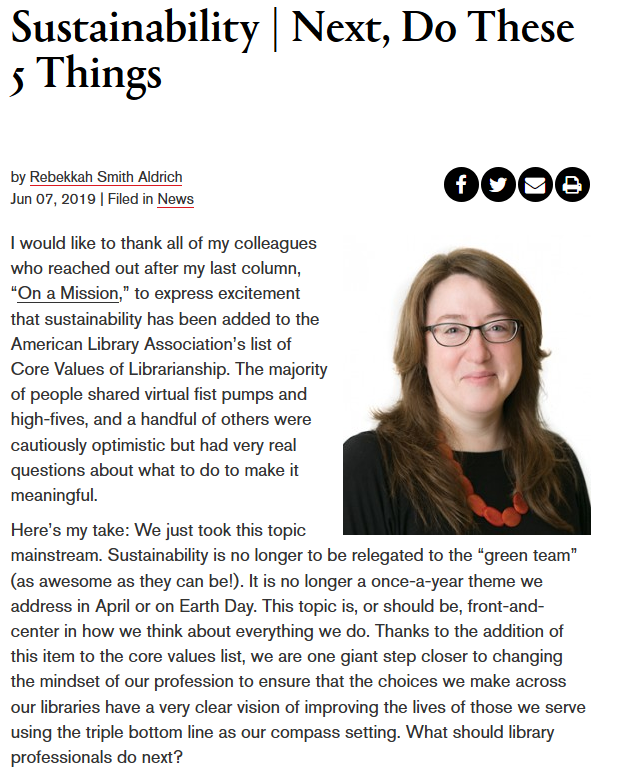
 After a hiatus, I’m back! My latest Library Journal column is now up:
Sustainability | On a Mission
The urgency behind sustainability work has been growing year by year and has picked up considerably with the issuance of two reports in fall 2018. The first was the United Nations Intergovernmental Panel on Climate Change’s latest, which came out in October. Written and edited by 91 scientists from 40 countries who analyzed more than 6,000 studies, the report finds that the immediate consequences of climate change are far more dire than originally predicted, calling for a transformation of the world economy at a speed and scale that has “no documented historic precedent.” The second report came out one month later: the Fourth National Climate Assessment, which found that societal efforts to respond to climate change have not expanded at the rate or scale needed to avoid substantial damages to the economy, the environment, and human health over the coming decades.
What are we to do? Where do we start? It’s overwhelming, but all we can do is take one step at a time and bring others along with us.
In January 2019, at the American Library Association (ALA) Midwinter Meeting in Seattle, the “Resolution for the Adoption of Sustainability as a Core Value of Librarianship” was adopted by ALA Council. This resolution addresses the first recommendation from the final report of the ALA Special Task Force on Sustainability…read the whole article here.
 At the 2019 Midwinter Conference of the American Library Association in Seattle, WA, sustainability was added to the list of core values of librarianship! This was the #1 recommendation from the ALA Special Task Force on Sustainability.
The resolution also calls for accreditation standards to evolve to ensure the topic of sustainability is an inherent element in library school curriculum!
This move by ALA Council is a historic moment in our profession, changing the course of how future leaders will think about libraries and librarians’ role on the topic, better positioning libraries to be leaders in their communities on this topic.
At the 2018 American Library Association (ALA) conference in New Orleans we submitted the final report of the Special Task Force on Sustainability. In eight months this task force took a hard look at where opportunities can be found for ALA, our profession and libraries to step up as leaders on the topic of sustainability.
Results of a national ALA membership survey indicate that ALA is not currently viewed as a leader on the topic of sustainability.
The final report outlines the efforts of this task force, shares the results of a membership survey and provides 52 recommendations to help advance the impact libraries can have to help their communities thrive in the future.
It was a pleasure serving on this task force. I am proud of the work we did. However, there is much to be done. I introduced this report to the ALA Council on Monday of the conference and the timing of my presentation on the agenda was pretty interesting. I was up after Council narrowly voted down a resolution that strongly suggested an increase in socially responsible investing and a divestment of fossil fuel holdings.
Those who serve on Council are good people, trying to balance the economics of the investment strategy while upholding our core values, not always an easy thing. This resolution has been brought up for a vote before, several times in fact, and each time a few more people vote for it. People are educating themselves, drawing a line in the sand about how far they are willing to compromise their values.
The world is changing and our thinking on many things must change too. Sustainability is not a destination. It is a way of thinking. The evolution of our profession must adopt this mindset and we’ve got a strong start in that direction with the report of this task force.
Stay tuned!
 “Resilience,” by Rebekkah Smith Aldrich, is the first volume to be published in a new series from ALA’s Center for the Future of Libraries. The Library Futures Series is edited by Miguel A. Figueroa, Director of the Center for the Future of Libraries, and produced in collaboration with ALA Neal-Schuman. It focuses on emerging trends in the profession, provoking discussion on how to shape the future by sharing ideas and exploring joint solutions to the challenges facing libraries and society.
Resilience (or resiliency) incorporates preparations for and rapid recovery from physical, social, and economic disruptions, including environmental disasters, terrorist attacks, or economic collapse. As city, state, and the federal governments adopt resiliency as a strategy for addressing potential disasters, libraries may need to align their facilities, services, and programs to demonstrate a resilient strategy. Additionally, libraries may find themselves competing for funding with other programs or initiatives, especially in an increasingly limited pool of government spending. A founding member of ALA’s Sustainability Round Table, and a longtime public library development consultant, in this book Aldrich discusses how resilience can align with library values of equity and access, and why libraries and information professionals may be ideal partners or providers in helping individuals and the communities which they serve adopt resilient practices. This thought-provoking treatment of timely topic offers important points of consideration for library administrators and managers, as well as scholars of urban planning, public policy, disaster recovery, and related disciplines.”
-From the 6.14.2018 ALA Press Release:
 Certified Sustainable | Library Design
by Lisa Peet
When the New York Library Association (NYLA) Council adopted its Resolution on the Importance of Sustainable Libraries in early 2014—the American Library Association (ALA) passed its own version at the June 2015 annual conference—it stated that NYLA “enthusiastically encourages activities by its membership—and itself—to be proactive in their application of sustainable thinking in the areas of their facilities, operations, policy, technology, programming and partnerships.”
As of November 2017, NYLA has moved beyond enthusiastic encouragement to structured guidance with the launch of its Sustainable Libraries Certification Program (SLCP). The multipart benchmarking system developed by the NYLA Sustainability Initiative (SI) leads library administration, staff, and boards through a process to help them create and maintain sustainable organizations.
 SLCP combines actionable steps, policy suggestions, and data-gathering tools; participants also receive support from technical advisors and one another through in-person and online meet-ups and webinars. The program’s 12 categories include….Read the full article here.

 Author of Sustainable Thinking: Ensuring Your Library’s Future in an Uncertain World and Resilience, Rebekkah Smith Aldrich has been a public library development consultant since 1998. Rebekkah currently holds the position of Coordinator for Library Sustainability at the Mid-Hudson Library System in New York where she assists 66 public libraries in the areas of governance, management, funding and facilities. Rebekkah is a certified Sustainable Building Advisor (cSBA), Leadership in Energy & Environmental Design Accredited Professional (LEED AP) and a holds an advanced certificate in Public Library Administration from the Palmer School of Library and Information Science at Long Island University. A founding member of the American Library Association’s Sustainability Round Table (SustainRT), Rebekkah spearheaded the passage of the American Library Association’s Resolution on the Importance of Sustainable Libraries. Active in the New York Library Association (NYLA), Rebekkah is co-founder, and co-chair, of the NYLA Sustainability Initiative Committee. Named a Library Journal Mover & Shaker in 2010, Rebekkah is Library Journal’s sustainability columnist and a frequent presenter at libraries and conferences around the US.

For the past several years the library world has been abuzz with the concept of “sustainable thinking.” Yes, we all want to help the environment and also ensure that libraries are on board too. But beyond being just a feel-good catchphrase, how does sustainable thinking translate into concrete action? Rebekkah Smith Aldrich explores exactly that in her new book, and in this interview she discusses how many libraries are taking the initiative in areas ranging from community outreach and programming to building design.
You’ve done quite a bit of writing for various publications, including your regular column for Library Journal, but this is your first book. What was different about doing this kind of long-form piece? What were your biggest challenges?
At first, I thought to myself, no problem, it’s just like writing a series of articles like I do for Library Journal. I did the math, figured out my word count and went for it. But that approach really didn’t work. There is an element of storytelling necessary to make the case, build buy-in and inspire people to keep reading so they are primed for the work ahead.
It took me several tries to find the right “arc” to the story. Each chapter required that I have a plan, that I was purposefully helping the reader walk through the story as it had evolved for me over the past decade. Ensuring I carried the thread throughout the work rather than writing several 800-word essays that might come across as disjoined was important. The work was to balance the enormity of the topic with a call to action that then led the reader to pragmatic steps that library leaders could relate to, regardless of the size of their library. Keeping things simple, well-defined and justified definitely took more time than I had anticipated.
How did your experience as a founding member of New York Library Association’s Sustainability Initiative guide your book?….Read the full interview here.